
A family of five gathers around the dinner table after a long day. The aroma of fresh paneer fills the room.
“Paneer butter masala today?” the youngest asks excitedly.
Alongside it sits paneer tikka, kadai paneer, shahi paneer, and soft paneer stuffed parathas. The family laughs, eats, and enjoys every bite.
“This is the softest paneer I’ve ever had,” says the grandfather with a smile.
The dinner ends happily. Plates are cleared. Lights go off.
But pause for a moment.
Have you ever wondered what happens inside a paneer factory after those neatly packed paneer blocks leave for supermarkets, restaurants, and homes?
For every kilogram of paneer produced, a large quantity of paneer whey is generated as residue. And while paneer brings revenue to dairy businesses, paneer whey often becomes one of the most difficult wastewater streams to manage.
This is where the real story of dairy wastewater treatment begins.
The Daily Challenge Most People Never See
Paneer whey may look harmless at first. But inside dairy factories, it can quickly become a serious operational challenge if not handled properly.
Paneer whey is highly biodegradable and contains a heavy organic load. According to treatment observations, paneer whey effluent can have:
·Inlet COD levels reaching up to 80,000 ppm
·Acidic pH around 4–5
·High protein content leading to sludge formation
At the same time, its high biodegradability also creates an opportunity for effective biological treatment when the right process is used.
For dairy factory owners and MSMEs, the problem is rarely just “wastewater.” It slowly starts affecting operations, labour, hygiene, and even brand reputation.
The Operational Pressure Behind Paneer Production
Many dairy businesses silently struggle with issues like:
Bad Odour and Fast Fermentation
Paneer whey spoils quickly when stored improperly.
·Fermentation can create strong unpleasant odours
·Nearby complaints may increase over time
·Working conditions inside the plant become uncomfortable
Drain Choking and Disposal Difficulties
The high organic nature of whey makes disposal challenging.
·Overflow and choking issues may occur
·Daily disposal becomes labour-intensive
·Transportation and handling costs keep increasing
Pollution and Compliance Concerns
Untreated or poorly treated wastewater can create environmental stress.
·Groundwater and nearby water sources may get affected
·Pollution control standards become difficult to maintain
·Frequent monitoring and corrective action may be required
Reputation and Business Impact
Today, word of mouth travels fast.
·Unhygienic surroundings can affect public perception
·Local complaints may damage trust slowly
·Operational stress starts affecting overall business focus
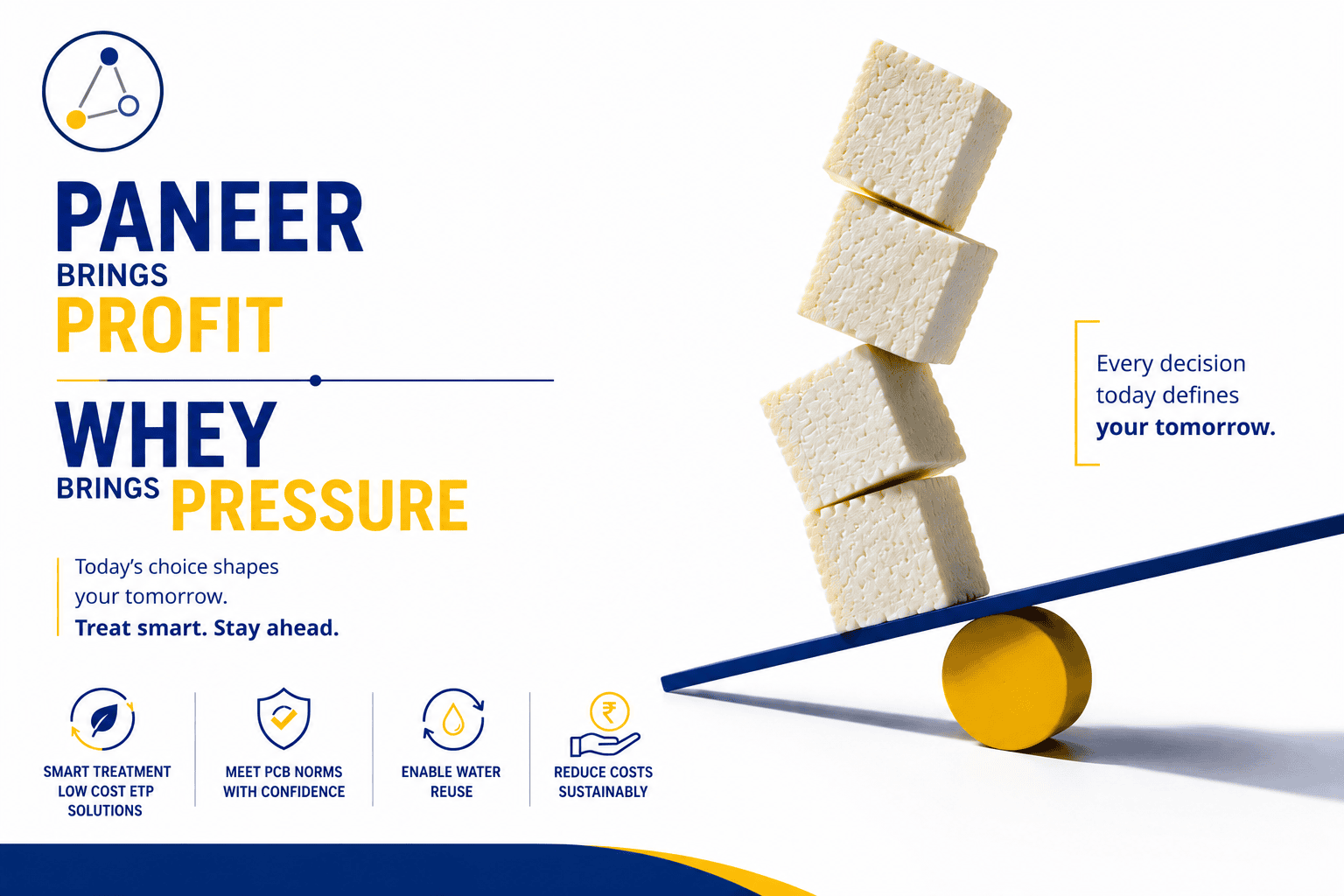
Paneer brings profit.
But unmanaged whey brings pressure.
And most factory owners do not want unnecessary operational burdens standing between them and business growth.
Why Traditional ETPs Sometimes Still Struggle
Many dairy factories already have some form of dairy effluent treatment plant installed.
Yet in several cases, owners continue facing recurring issues.
Not because they ignored treatment.
But because paneer whey is a highly challenging wastewater stream.
Conventional systems such as Activated Sludge Process (ASP) and MBBR systems often require:
·Continuous aeration through blowers
·Significant chemical usage
·Skilled operators for regular monitoring
·Secondary settling and sludge handling
·Higher recurring operational expenses
In many cases, factories also experience:
·Persistent odour even after treatment
·Difficulty in handling high organic loads consistently
·Rising electricity consumption
·High sludge generation
·Unsatisfactory long-term operational experience
For MSMEs especially, the challenge is not just installation.
It is sustainability.
A dairy ETP plant should not become another operational burden.
So What Exactly Is an ETP?
An Effluent Treatment Plant (ETP) is a system designed to treat industrial wastewater before discharge or reuse.
In paneer factories, ETPs help manage whey wastewater treatment by reducing pollutants, improving water quality, and supporting cleaner operations.
A good paneer factory ETP should ideally help:
·Reduce organic load effectively
·Minimize odour issues
·Lower operational complexity
·Reduce recurring costs
·Improve treatment consistency
·Support pollution control compliance
·Enable treated water reuse wherever possible
But not every ETP works the same way.
The process design matters.
A Different Approach to Paneer Whey Treatment
At Biofilm Engineers, the approach focuses on making dairy wastewater treatment simpler, cleaner, and operationally practical.
The treatment flow includes:
·Pre-treatment
·Quorum Bio-reactor
·UV/Ozone polishing
·Treated water for reuse
The system is designed to operate with:
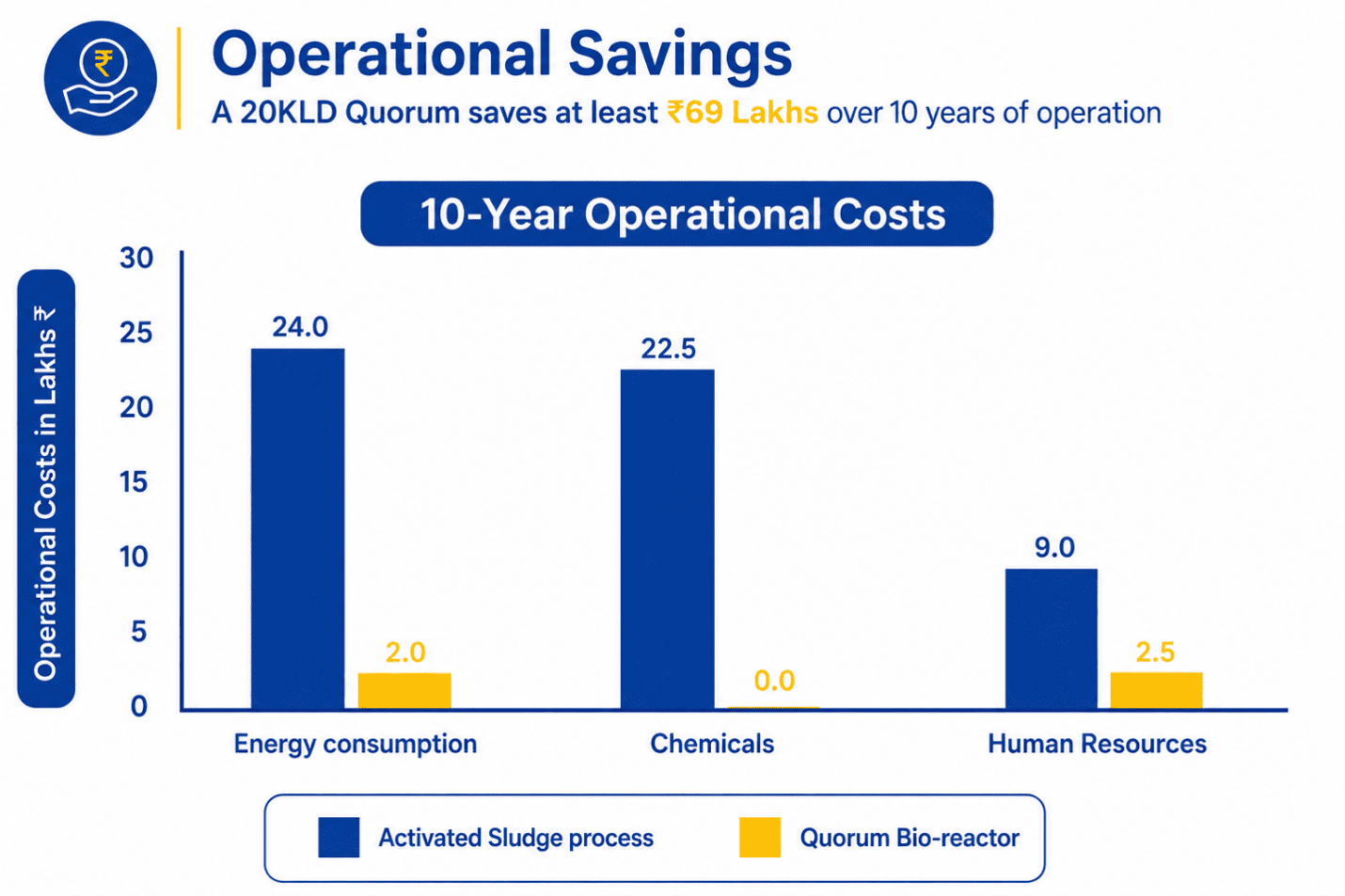
·More than 90% operational expenditure reduction
·No chemical dependency during treatment
·Autonomous process control
·No secondary solids production
One of the biggest differences lies in the reactor design itself.
Unlike conventional submerged systems that rely heavily on artificial aeration, the Quorum Bio-reactor uses a non-submerged fixed film process with natural draft-based aeration.
This helps reduce energy dependency significantly.
Real-World Operational Observation
In a 20 KLD paneer whey ETP installation at United Valley Foods India, Sullurupet, Andhra Pradesh, the following single-pass biofilter results were observed:
Parameter | Inlet | Outlet | Removal |
pH | 4.31 | 6.71 | — |
BOD (mg/L) | 769 | 138 | 82.1% |
COD (mg/L) | 3637 | 560 | 84.6% |
TSS (mg/L) | 156 | 42 | 73.1% |
The operational cost observed was less than INR 100/day.
With a properly designed double-pass treatment approach, Pollution Control Board discharge norms can also be achieved more effectively for challenging paneer whey wastewater streams.
These results indicate how biological process optimization can reduce treatment burden while maintaining practical operational efficiency.
Why Biofilm-Based Systems Are Gaining Attention
Modern dairy wastewater treatment is gradually moving towards advanced biofilm technologies because of their higher microbial surface area and treatment efficiency.
Compared to conventional systems:
·Conventional media may provide 500–5000 m²/m³ surface area
·Advanced biofilm carriers can provide extremely high microbial growth area
·Lower diffusion resistance improves treatment efficiency
·Natural oxygen transfer reduces blower dependency
The result?
Lower energy usage. Lower sludge generation. Lower chemical dependency. Simpler operations.
For dairy MSMEs, these are not just technical advantages.
They directly affect profitability, labour management, and long-term peace of mind.
Cleaner Operations Are Becoming a Business Necessity
Today, dairy businesses are evolving quickly.
Customers expect hygiene. Authorities expect compliance. Factories expect sustainability.
And owners want systems that work quietly in the background without creating new operational headaches.
The future of paneer whey treatment is not about fear.
It is about responsible growth.
Because a successful dairy business should focus more on producing quality products — not constantly worrying about wastewater disposal every single day.
A Quiet Step Towards Better Dairy Operations
At Biofilm Engineers, the goal is simple.
To help dairy factories move towards cleaner, calmer, and more manageable wastewater treatment systems through carefully designed biological treatment solutions.
No exaggerated promises. No unnecessary complexity.
Just practical engineering focused on operational comfort, lower recurring burden, and long-term treatment stability.
Every dairy factory has its own challenges. Every wastewater stream behaves differently.
But with the right treatment approach, paneer whey does not have to remain a daily operational pressure.
Sometimes, the best industrial systems are the ones that quietly solve problems before they grow louder.
And for many dairy businesses, that quiet change can make all the difference.