
Three wins. Three relieved families. Three "successful days" for the hospital.
But here's the question almost nobody in the building is asking:
Where did the water go?
Not the drinking water. The other water: the one that rinsed the ICU floor, flushed the OT drains, washed the lab glassware, and carried away what the human body and modern medicine leave behind. That water didn't just disappear down a pipe and vanish into thin air. It went somewhere. And unless a hospital has an Effluent Treatment Plant (ETP) actually built for hospital wastewater, not just any generic sewage system, that "somewhere" is often a drain, a river, or the groundwater your own city drinks from.
This is the story most hospitals don't tell you. Let's tell it properly.
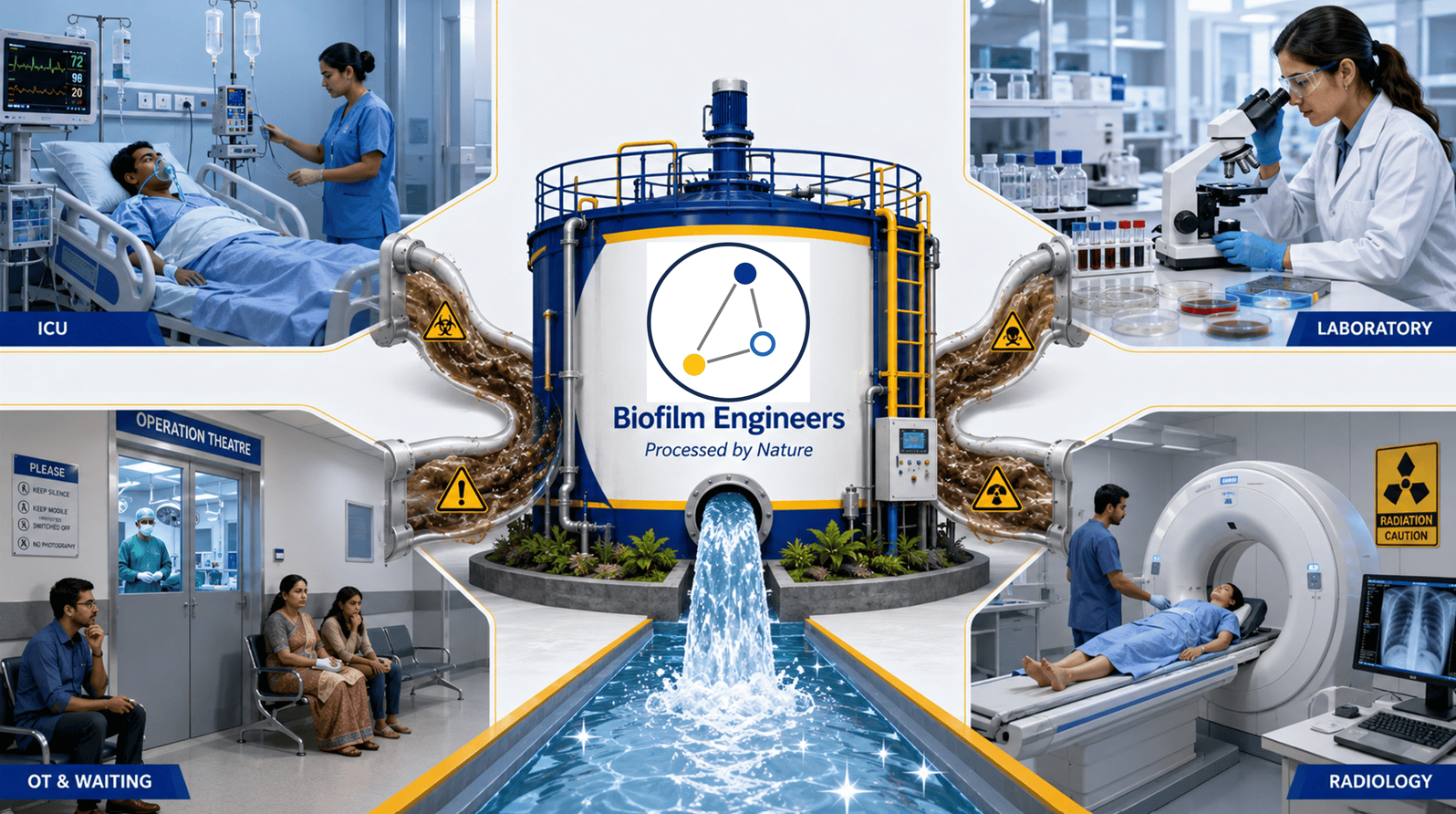
HOSPITAL WASTEWATER IS NOT "JUST SEWAGE." IT'S A COCKTAIL
"Most explanations of hospital wastewater treatment stop at the basic stages: preliminary, primary, secondary, tertiary. That's useful groundwork, but it doesn't answer the real question: why does hospital wastewater deserve a category of its own, separate from apartment or office sewage?"
A residential building's wastewater is mostly what you'd expect: soap, food waste, human waste. A hospital's wastewater carries all of that, plus something municipal treatment systems were never designed to handle: active pathogens, antibiotic residues, and antibiotic-resistant genes travelling together in the same drop of water.
Think about that combination for a second. You're not just sending dirty water downstream. You're potentially sending bacteria that have already learned to survive antibiotics, because they were bathed in sub-lethal doses of medicine before they ever left the building. Researchers studying hospital effluent have found it can carry meropenem, cefepime, and other last-resort antibiotics straight into the drain, alongside the very bacteria those drugs were meant to defeat. That's not pollution in the ordinary sense. That's a training ground for superbugs, and it's leaving through your outlet pipe.
THE FOUR ROOMS NOBODY THINKS ABOUT, UNTIL NOW
Every hospital has departments that patients associate with healing. Very few people ever picture what those same departments send into the drain. Here are four units where the story gets genuinely eye-opening.
1. The ICU: where the sickest patients meet the strongest medicines
The ICU treats the most vulnerable patients with the most aggressive antibiotic regimens available. That means ICU wastewater is disproportionately loaded with antibiotic-resistant bacteria compared to almost any other part of the hospital. Studies tracking resistance genes across hospital wastewater collection points consistently find ICU-linked drains among the highest-risk sources, a direct reflection of how much antimicrobial firepower is used, and how much of it exits, largely unchanged, in the wastewater.
2. The Operation Theatre: sterile inside, far from sterile in the drain
Inside the OT, everything is engineered to be spotless. But the water that washes instruments, cleans the floor, and flushes surgical waste carries blood, tissue fragments, disinfectant residues, and, again, antibiotic traces from pre- and post-operative dosing. It's one of the discharge points researchers specifically flag as a hub where hospital wastewater "converges" before leaving the premises.
3. The Pathology and Microbiology Lab: the irony hiding in plain sight
This is where doctors identify infections so they can be treated. And this is also where stock cultures, testing reagents, nutrient media used to grow bacteria for diagnosis, and disposed biological samples enter the wastewater stream. A lab built to identify pathogens can, without proper treatment downstream, become a quiet source that releases them.
4. Radiology and Diagnostics: the pollutant category most people never expect
Ask anyone what hospital wastewater contains and they'll say "germs." Almost nobody says "radioactive isotopes." But diagnostic imaging and nuclear medicine departments do generate trace radioactive material that can enter wastewater, alongside the contrast agents and chemical residues used in scans. It's the one hospital pollutant category that has nothing to do with biology at all, and it's exactly why a hospital ETP can't be a copy-paste of a factory or apartment system.
Four departments. Four completely different pollutant signatures. One outlet pipe. That's the real complexity of hospital effluent, and it's why treating it "generally" is not the same as treating it correctly.
SO WHY DOES THIS WATER MATTER SO MUCH?
Because untreated or under-treated hospital effluent doesn't stay inside hospital boundaries. It reaches the municipal sewage line, a nearby water body, or the groundwater table, the same groundwater that borewells across the city draw from. When that happens, three things quietly occur:
- Disease-causing pathogens re-enter the human environment, this time outside the controlled setting of a hospital ward.
- Antibiotic-resistant bacteria get an open pathway to spread, into rivers, soil, and eventually back into the food and water chain.
- The hospital itself becomes exposed to regulatory risk: Pollution Control Board non-compliance, penalties, and in serious cases, closure notices, especially as Indian regulations around Biomedical Waste and Effluent discharge tighten.
None of this is meant to alarm you unnecessarily. It's meant to reframe a question hospital rarely ask out loud: if the ICU, OT, lab, and radiology department all discharge such different things, why would one basic system be enough to treat all of it safely?
WHAT HOSPITAL WASTEWATER ACTUALLY NEEDS
An hospital ETP has to do more than remove suspended solids and organic load, the job most conventional systems are content with. It needs to:
- Neutralise pathogenic load meaningfully before discharge, not just reduce turbidity
- Handle the biological "unpredictability" of a mixed stream: ICU one hour, lab discharge the next
- Work reliably without constant manual monitoring, because hospital staff are (rightly) focused on patients, not plant operations
- Run quietly and without odour, in a building where noise and smell directly affect patient recovery and comfort
- Stay compliant with discharge norms every single day, not just on the day of inspection
This is exactly where biological treatment technology earns its place. At Biofilm Engineers, our Quorum Bio-Reactor uses a fixed-film biofilm process, bacteria naturally colonising a high-surface-area packing media, to break down organic pollutants and nutrients without external chemical dosing or heavy mechanical aeration. It's a nature-based process doing precision work, designed to run steadily in demanding, round-the-clock environments like hospitals, the same kind of environments where we've already deployed it for institutions with continuous, non-negotiable discharge needs.
THE REAL QUESTION TO ASK YOUR FACILITY TEAM
Not "do we have an STP" or "do we have an ETP." Almost every hospital does, on paper.
The real question is: does our current system actually understand what an ICU, an OT, a pathology lab, and a radiology unit are sending it, or is it treating everything like it came from a bathroom sink?
That one question, asked honestly, tells you whether your hospital's wastewater story ends safely, or quietly becomes someone else's problem, downstream, in the water table your own patients, staff, and neighbourhood will drink from next.
Biofilm Engineers designs nature-based STP and ETP systems for hospitals, resorts, corporate campuses, and dairy industries, built to handle what generic systems can't. If your hospital's effluent system hasn't been evaluated for pathogen load and biological safety, get in touch, we'll help you look at it properly.